Disobedient stuff
View more presentations from mdaele.
Weight log: 214lb
The waiter approached our table he’s had two trays of steaming hot food in his hands. They looked delicious. He set them down in front of me and my dinner guest. As we both picked up our forks, the older man swung the conversation around to one of his favourite ideas. Alienation.
I’ve talked about the idea of alienation before and I bring it up again because I think it is important to uncover the way social frames, informed by capitalist sensibilities, operate to negate meaningful resistance or protest to repression in all its forms.
Alienation, the old codger started, is what happens to the individual who only possesses the effort of her/his labour. The labourer no longer owns or possesses the work of his/her hands and so must stand a distance to whatever product he/she makes out of her/his labour. The grey beard Karl reminded me of how important this was for him as he watched the early Industrial Revolution emerging. Since labour was largely invisible it was a prime site for repression. So Marx predicted that capitalism would fail as the working class would revolt and demand a different way of exchanging their labour.
You sure sucked as prophet. – I told him not blinking. What you did not count on but perhaps should have predicted was that capitalism might actually be able to preserve itself by transforming the worker into a consumer. So that now a worker could ignore the alienation of his/her labour because it helped her/him be a better consumer. The wages of labour now paid for consumer goods which with growing demand caused the need for more consumer goods which meant more labour was needed to make more consumer goods.
Buddy Karl put down his fork in disgust and walked away from the table. And while he was over in the boy’s room freshening up our pal Herbert Marcuse wandered up and sat down in Karl’s place. He picked up Karl’s fork and proceeded to chow down. After a few bites he looked up and said…
We are again confronted with one of the most vexing aspects of advanced industrial civilization: the rational character of its irrationality. Its productivity and efficiency, its capacity to increase and spread comforts, to turn waste into need, and destruction into construction, the extent to which this civilization transforms the object world into an extension of man's mind and body makes the very notion of alienation questionable. The people recognize themselves in their commodities; they find their soul in their automobile, hi-fi set, split-level home, kitchen equipment. The very mechanism which ties the individual to his society has changed, and social control is anchored in the new needs which it has produced.
I have just suggested that the concept of alienation seems to become questionable when the individuals identify themselves with the existence which is imposed upon them and have in it their own development and satisfaction. This identification is not illusion but reality. However, the reality constitutes a more progressive stage of alienation. The latter has become entirely objective; the subject which is alienated is swallowed up by its alienated existence. There is only one dimension, and it is everywhere and in all forms. The achievements of progress defy ideological indictment as well as justification; before their tribunal, the "false consciousness of their rationality becomes the true consciousness”.
a link to this essay can be found here
Now we see the trouble brewing in the pot all along. The object; the cell phone, the SUV (or more pejoratively the minivan), the coffee pot, the brand of soda pop, the hamburger, the ginger beef – become and an extension of ourselves. Of course its hard to choke all that down but then we have to remember to pick out the bones. Marcuse was not telling us that we have become the object – only that our identity is unavailable and inseparable from the objects/commodities which we use.
The waiter is standing at our table again waiting to be paid. So as I reach into my pocket for some loonies I am moved to ask the kind fellow – What do you call that meal we ordered here today. I’d like to order it again.
Well sir -the boy replies confidently- it is our special today 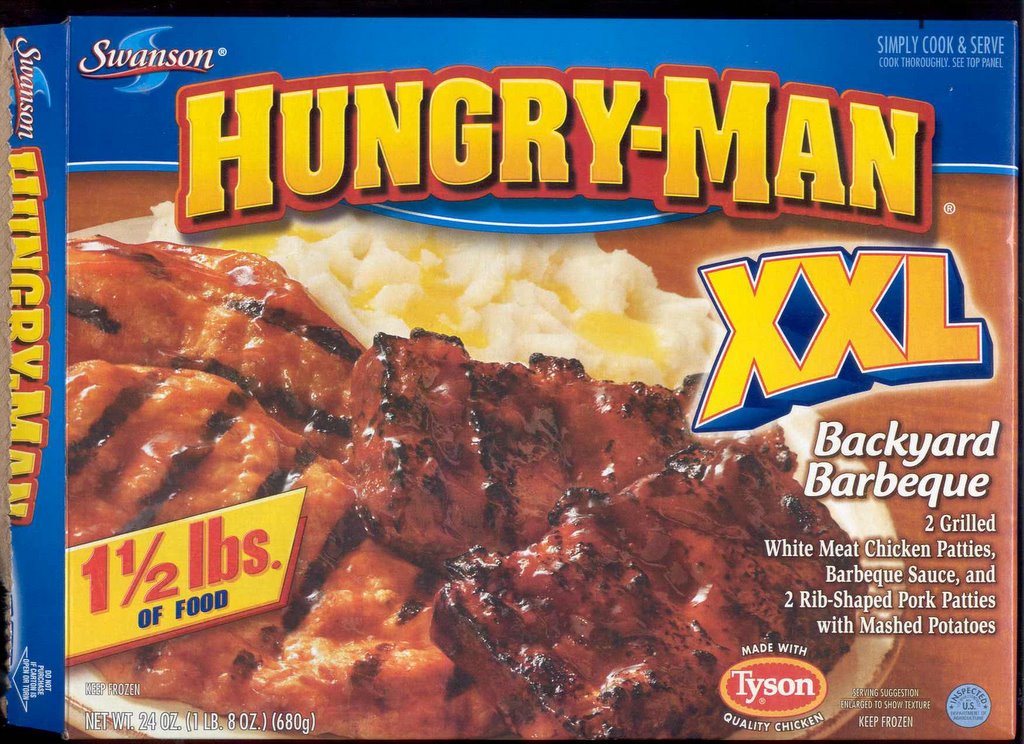 Hungry Man. The succulent meat like substance that you enjoyed was processed by roughly 92 foreign illegal workers at meat packing plant in the U.S. mid-west just before they were rounded up and shipped back to their home country. The animals they used were inhumanely held in cramped cells standing in their own feces everyday. The vegetables you ate were reconstituted by a crew of youth on a summer job program. I’m sure you can appreciate just how close actual vegetables those items tasted and even at that young age these youth really know how make it all look so realistic. – the waiter stopped to take a breath.
Seriously? –I cut in impatiently pulling out my plastic- are trying to pull a fast one on me young man? I mean there is no way that this meal came from all those places. Did you not tell me this was a Hungry Man Meal?
Why yes sir I did. –he was backing down sheepishly-
Well then stop with this nonsense and process my credit card. –i was cranky- next time don’t try to dazzle me with all your fictions just admit it, you got this out of the freezer at the grocery store?
yes sir
I left the boy a sizable tip…he’s gonna need a good education…
I had a wonderful conversation – I should rephrase that – I ended up talking a poor fellows ear off this afternoon. While waiting for the wedding reception to begin I had the opportunity to discuss the scope of my research. I take any chance I can get.
Food is such a common object and so much a part of our everyday. Because it is so common drawing it out into the light to be examined gives it a special status. In any social analysis it is possible to miss the embedded environment of the social facts merely by focusing to directly on a single factor. I really want to avoid that from happening in this case. That’s why this conversation was heart-warming.
People are generally interested in food and especially if it is tied to a thinner body image but mostly people are not that interested in trying to think with food. This is a highly abstract endeavour. I’m not sure that people are really interested in thinking about how food might be conveying meaning about the kind of person that they are. I don’t blame them. There are many times when it would be easier to stop thinking so hard about something that I usually paid very little attention to. So when someone is willing to engage with me in batting around semiotic theory or other elements it is a treat.
Sometimes there are tiny cracks and windows into the real life of an object that has existed seamlessly as something we’ve hardly paid attention to. Sometime we look down at our plate and think why does the idea that some of my food is touching on the plate such a big deal for me? Why am I eating this right now? Or what does feeding cake to your newly minted spouse have to do with love? Why is mac and cheese not a usual banquet menu item? Or how does Trina make those darn chocolate chip cookies so tasty?
So I have a question for you. Have you ever experienced a moment when food has startled you – surprized you – or made you stop to wonder what was going on? If so tell me about it…
 Is it any wonder that this KFC treatsie has obscure yet intentional sexual overtones in its name?


this video so totally matches up with a wicked cool story from today at supper. So my second youngest son stayed home from school today. He was supposed to go with someone for “Take your kid to work day” but he couldn’t go with Char to do catheters and pik lines and no other arrangements could'/were made so…
Char said, “Fine, you are going to stay home and find out what its like to be a house wife.” She lined up a bunch of chores for him to do around the house and i threw in a few as well. Bam he worked pretty much all day. I did take him to Dairy Queen for lunch (like I always did with Char every day when she was house bound as a house wife :))
Guess who made supper? – you guessed it! Now we are a family who still prays before we eat our meal. We tend to not use the memorized prayers but the content and format usually do not vary much. So tonight my youngest prays and as he says “…and bless the hand that have prepared this…” our grade nine ‘house wife’ throws up his hands like a football referee indicating a touchdown. He grins as I look over at him with a pretty blanked out look…
“That was me!” he says, “That was me!” He made the food – he got the credit and his hands got blessed in the process. What happened there in that moment is profound. Think of all the ways that scene comments on gender roles and the relegation of certain tasks into obscurity… Think of what that scene potentially says about for whom prayer is meaningful and how prayer operates either to create a certain kind of distance or to actually acknowledge engagement. Here is what I mean. There is a whole lot of work that has gone into getting the food we ate for supper onto the table. My sons work might actually be the least demanding. The table prayer is intended to reflect gratitude for this labour from which the rest of the family is benefitting. But is it possible that the prayer might actually be making the labour of getting the food onto the table disappear since it ultimately gives God credit for stuff that human beings spent a lot of effort producing. Don’t get me wrong – it not as if I don’t recognize that God ultimately is the source behind the food we get to eat. In a way (and i know this may not be popular to say) praying this prayer of blessing sort of allows to stop accounting for the guilt of not having worked very hard to make this food a reality. This video throws that door wide open. It seems to say look everything is already pre-packaged and pre-prepared but in order to allow yourself that unadulterated access to this food without having to even acknowledge the ‘ultimate’ divine source makes the alienation with the food complete. Now it is possible for food to exist without source – like it just appears on the Grocery Store shelves by magic – like manna appearing on the desert floor. The ludicrous nature of that idea should be apparent. I mean even the militant atheist would have to acknowledge that it takes a far weirder and outlandish faith to believe that stuff just appears on grocery store shelves than it does to believe that God is the source of all food.
In the end the disservice (the thing that does not get blessed) may lie in the fact that we are not really engaged in the production of our food.
So bless the farmer and the butcher and the meat wrapper and stock boy and the cart picker-upper dude in the parking lot. God bless the stove maker and the assembly line designer and the tortilla maker and the fertilizer distributer and the farmer who is wandering towards Christmas this year without so much as sniff of a profit line to show for all the rain and hope he has poured into the fields he tends. And God bless my son.
a special thank-you to the anonymous contributor who brought this video to my attention – storing up riches in…
Weight Log: 219lbs (I’m getting impatient-get to a hundred already!)
Ingested (Tuesday November 2nd): 1 fairly large and delicious Ambrosia apple, 10 oven baked french fries, about three teaspoons worth of sampling my newly made spicy ketchup, 1 pot of coffee, 2 cans of diet coke. = Caloric intake: 240; Fat grams: 4.6
Old Man Descartes – you know the guy who said, “I think therefore, I am” ---well he also said that the body is a machine. And if it is a machine then whammo it needs a source of energy – Right? There is no doubt that we tend to view our bodies as machines and we view food as the fuel. The idea that food is fuel to help our body function makes a certain amount of sense but we can clearly see where that idea is far from complete. Who really thinks about fuelling up their body as they sit down for a turkey dinner at Thanksgiving? So food is obviously way more than just fuel. But as soon as you want to talk about nutrition, weight loss, weight gain, training regimens, etc. the food as fuel and body as machine imagery becomes dominant – and ultimately constraining. I think it is interesting that we have something like a calorie counter that can measure a typical type of food in its potential calories like we have here: http://www.caloriescount.org/cgi/Enhanced_calcalc/enhanced_calcalc.cgi. Its strange really to think that this is possible because it is still completely unclear how exactly the body processes different types of calories and how they are used or stored in the body. This arbitrary calculator can now tell me how much energy I have just fed my machine.
But the story is a bit bigger than that. If food is fuel and the body is a machine. Then it becomes important to put the right kind and amount of fuel into your body. It is also possible to use the body as a reference for the kind and amount of food consumed. A body with that is fat has more than likely taken in too much fuel and a likely also the wrong type of fuel. A body that is fit and lean is taking in the right amount and the right kind of food. That would be the connotative logic – Right? But here too we notice something going on in the background. Thinner and fitter does not necessarily mean that the fuel consumption is appropriate – consider anorexia nervosa. This is where the real fiction is exposed though.
One would never judge the hauling capacity of a pick-up truck by analyzing its fuel. Nor would one ever say that a smaller leaner truck would be a more capable truck than a large one would be. So the idea of the body as machine and of food as fuel disappears as meaningful when it is paralleled with other machines and fuels. Still the body/machine-food/fuel metaphor persists. It has a long history of usefulness – especially once European nations emerged from a perpetual state of potential famine – much the same time as the Enlightenment was catching fire. This metaphor was first used to address what seemed to be very unfit soldiers who were failing on the battlefields of the various wars of the era.
Now we are in a place where the motivation is not toward the ability to carry out our duties as soldiers but rather that we are able to display in/on our bodies the appropriately idyllic gendered body type. Being a fit machine is important for aesthetic reasons not for functional ones. If you want proof listen to the group of guys or girls talking about what they find attractive in the opposite gender. I doubt you will ever hear a girl say - “Oh and by the way did you know that he can lift 300lb on the bench press?” and you certainly won’t hear a guy say, “you see those legs on that girl I bet she can burn out an elliptical machine with those…” (unless I have intoned some crass sexual euphemism unawares). The body machine now should have those functional qualities but not for their own sake but for the mark that these functions can leave on the aesthetic of the body. So now fuel is not only about being able to run an efficient machine but to allow that machine to produce the appropriate body.
Now glance back at the information I documented above. If I hadn’t confessed to you that it was my intake – you might guess that this record might belong to someone with an eating disorder. It does not. It belongs to me. And I defy you to figure out a way that what is represented as fuel can account for the flaps and bumps and bulges that are left on my body – even though functionally I might be in the best ‘shape’ of my life…
Weight log: 218lb
Today I could have run for what felt like hours on that treadmill. I felt so good. 3.5 miles an hour for 60 minutes. Plus I actually ran for 6 whole minutes at top speed – to the rhythm of “She’s a Maniac". I starting to get strategies in place for keeping my ‘fitness’ regimen going while in Mexico. Lots of planning.
Today I was feeling overwhelmed – still feel that way. Too much work to do before I feel I can be ready for Mexico. I am need to get a lot of work done in advance and today it felt like the work is just insurmountable. I don’t want to feel pressure out there because this is supposed to be a celebration of our wedding anniversary. I am worried that I will be a grumpy old dog with all this stuff hanging over me. The treadmill seemed like the one thing that I could be in control of and it was almost like an escape. In fact if I am totally honest (imagine having to declare that fact) it felt very much the same way I have often experienced ‘comfort food’. It was like I was eating a big pile of mashed potatoes with gravy and huge juicy slice of turkey nestled into a huge dollop of cranberry sauce, stuffing, and some cinnamon pie. I know this stupid but i distinctly remember thing its almost like I’d like another serving of this treadmill stuff – Yikes – I am losing my mind.
“…and he’s dancing like he’s never danced before…”

you know this may actually constitute resistance…like a novelist using a pen and paper, like a cartographer using a three mast wooden ship to map the northwest passage, like a politician using the street corner, like a commuter using a horse and wagon, excess becomes resistance
Hmmm or Try this one out for SIZE!
Weight Log: 218lbs (32 pounds as of the beginning of September – that is 4.5 lbs per week)
I have a number of posts that are waiting for me to post but the hectic pace here these last few days has left me rather scattered so if some of this comes off even more disjointed than usual – I suppose my excuse is that I am just trying to get the stuff out the door.
I’ve done a fair bit of reading around the discourse of food and body image. One of the things that is important to uncover is the voices that are privileged to speak about the topic – that can regulate what can be said ‘with the true’ of any given subject. Obviously, I would be remiss to avoid the pervasive role of popular media. So I went hunting for television programs – well gosh I should say it was not much of a hunt – it was more like shooting fish in a barrel.
Television shows dealing with food and weight tend to come in several species: 1. Diet/weight loss shows (these can be stand alone shows like The Biggest Loser or my Big Fat Diet Show or incorporated into typically daytime talk shows i.e. Oprah, Dr. Phil, Dr. Oz, etc.) 2. Cooking shows (these are basically instructional videos – a how-to manual for the do-it-yourself chef (ideas of renovation and resistance should emerge here a la Daniel Miller) In this category I would include stand alone shows like Best Recipes Ever but also the recipe dissemination within talk shows as well) 3. Eating/Reality Shows (here the basic idea is an engagement with some ‘real’ life subject evaluating their cooking/eating habits – In here I would include Gordon Ramsay’s Hell’s Kitchen (sort of an Osbornes of cooking school), also Jamie Oliver’s Food Revolution which I have already talked about a little bit, and You are what you Eat) For those of you that are up on this stuff you might notice that I have left off your favourite food show – that is largely because I am clearly unable to talk about all or even most of these shows because they are so prolific. Let me focus on one group of shows that seem to form an interesting voice over what can and cannot be said about food and body image.
The Eating/Reality Shows have a routine narrative arc that seems to necessarily include a display of the amasses collection of food that the family or individual eats in one week – one day – one month – etc. Jamie Oliver even backed up a dump into a BFI bin to dump a load of congealed fat into it. The idea seems to be to create this spectacle of what is outlandish and grotesque as a way of challenging the subjects to consider how they are eating. Here are some examples:
the first five minutes of Jamie Oliver’s Food Revolution
or the last two minutes of You Are what you Eat
the following are screen captures from that those episodes…
So what is it about these pictures that are actually gross? Well, for one thing the food is jumbled together. If you ask my boys they’ll tell you its not cool if food that isn’t supposed to touch does touch. But even more these images are supposed to be revolting. Deep fried, pre-packaged food is displayed in such a way dripping and piled into each other panned and given close up shots that might emulate explicit illicit display. Its a virtually pornographic display of food. Food Porn! Its not that hard to see these heaped up tables as a virtual food orgy. The table is laden with immorality. Of course it can be even more gross because it can be easily equated to obesity. This is fat food that makes people fat and there is a whole lot of it…
But take a close look at the Screen shot labelled “C”. This is the healthy food display. Notice that the food in this shot is not piled up in the same helter-skelter fashion. In fact it most closely resembles what one might expect spilling out of the classic cornucopia. Even in the way these images are constructed moral distinction is evident.
A quick trip down the grocery store aisles reveals that the food piled up on the vulgar table is in fact the cheapest. It is also the food that has the longest shelf life. Let’s also be clear that french fries, pizza, pizza pops, hot dogs, pancakes, eggo waffles, and corn dogs are tasty. What exactly is being said when tasty cheap food is being constructed as disgusting? What are we saying when we construct the highest priced food with some of the least preferred flavours ( I mean who really likes Brussels sprouts without a heck of a lot of cheese sauce to ameliorate the flavour of the vegetable). Are we not suggesting that there is a class distinction at work in the selection of food? What is of concern is not the subjects (of these TV shows) actual health but the construction of class distinction through the association of food with moral judgement? The reality is that only the rich can afford to eat healthy.
Now look at this picture.


