Showing posts with label weight. Show all posts

Thursday, February 3, 2011

no ribbons please…

image Yoni Freedhoff over at Weighty Matters has posted a timely bit on the connection between health organizations and the Food Industry. Timely, given my recent post about the connection between Walmart and Michelle Obama. imageCHECK out this quotation from the posting:

The risk is straightforward. Partnerships by definition serve to benefit both parties. For the health organizations the benefits involve some combination of money, resources and exposure. For the food industry the benefits include sales, brand image improvements (which in turn translates into sales) and spin which may serve to help deflect criticism or further political needs.
The increase in sales is problematic in that more often than not, the brands that partner with health organizations are the very brands whose images or products may be considered unhealthy. Moreover, the consumption of more food, even more healthy food, won't help with our obesity problem.

Dude its time to quit clapping for Big Food and their healthy food schemes – lets just admit it – THEY ARE JUST IN IT FOR THE MONEY!

Still unconvinced read Wendell Berry’s article “The Pleasure of Eating” or read his books…

while you are waiting for those links to load think about this…

“This is certainly true also of patrons of the food industry, who have tended more and more to be mere consumers — passive, uncritical, and dependent. Indeed, this sort of consumption may be said to be one of the chief goals of industrial production. The food industrialists have by now persuaded millions of consumers to prefer food that is already prepared. They will grow, deliver, and cook your food for you and (just like your mother) beg you to eat it. That they do not yet offer to insert it, prechewed, into our mouth is only because they have found no profitable way to do so. We may rest assured that they would be glad to find such a way. The ideal industrial food consumer would be strapped to a table with a tube running from the food factory directly into his or her stomach…As capital replaces labor, it does so by substituting machines, drugs, and chemicals for human workers and for the natural health and fertility of the soil. The food is produced by any means or any shortcuts that will increase profits. And the business of the cosmeticians of advertising is to persuade the consumer that food so produced is good, tasty, healthful, and a guarantee of marital fidelity and long life.”

Monday, January 31, 2011

Food round up…

Weight Log: 195lbs

Ladies check this outimage brownies can accomplish so much more than just a tasty snack. They are the vehicle for grief moderation when that nasty boy has dumped you – so good right! Like a blanket against an icy cold cold heart – talk about comfort food – but then it also is the source of your guilty conscience. Good luck dealing with the stress of weight loss after you have packed on the pounds after he dumped you. Aren’t you lucky to be a girl with super huge expectations about what an attractive body should look like? Maybe you should shop at Bed Bath and Beyond instead – they know how to treat a girl right!

Since going public with my substantial weight loss I have had more women come up to me and tell me that they wished they could lose – 10, 15, 20 lbs. Really! No guy HAS EVER TOLD ME THAT EVER!!!!image So yeah good luck with that ladies! Now go ahead and watch the good folks over at TLC with their show “What Not To Wear” – its okay cause they are more reasonable than some of these crazy shows – who cares that they are still asking you to conform to the dominant values of attractiveness prescribed onto the female body. And besides if you follow their advice your consumer instincts will be honed so that at least in the clothes that you wear you will be able to comfortably fit the ideal that free market capitalism wants you to be.

If all of this is turning your stomach then you might want to turn to the other gateway food.

image Bacon – check out this link: http://www.npr.org/blogs/health/2011/01/30/133304206/why-bacon-is-a-gateway-to-meat-for-vegetarians#more

Oh and if you are interested here is a link to the presentation that me and my friend made in our Social Context class today: http://people.uleth.ca/~dale.friesen/Fat%20like%20Me/fatlikeme.pptx

Sunday, November 28, 2010

Embarrassed at McDonald’s

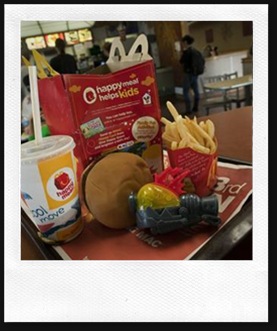
The Greasy-Eyed, Sheepish Apology usually goes something like this: “Oh, I just picked something up at McDicks.”101109_happy_meal.grid-6x2
Allen Shelton noticed that when his fellow professors admitted to eating a Quarter Pounder and fries they talked about it as if, “this was an activity which in one way or another had been forced on them…They were vaguely apologetic or embarrassed by their presence there.” -- (Theatre for Eating, Looking and Thinking: the Restaurant as Symbolic Space)
McDonalds never seems to get the same ecstatic revelry from its patrons as say the Keg, or even Boston Pizza. “Yeah, you know I tried those new McMinis and they’re not that bad – actually.” Where as on the other hand you get…”If go to that new Indian place on 4th Ave. you just have to try the Baingan Bharta it is to die for!” Of course, it is not uncommon to hear criticism of all restaurants but even there a different type of language is used. “The portions at Ric’s Grill are small for the price and the food is just average – nothing outstanding.” Compared to…”Can you believe that they are actually bringing the McRib back? – That is just disgusting!” The differences are subtle but the way we talk about the food we eat at a restaurant says something important about what is “going on” in a restaurant.
Shelton’s article gives us a pretty convincing argument that a class analysis is available when we look at restaurants. He suggests a high end restaurant like Ric’s Grill or the Keg corresponds loosely to a high class identification. Boston Pizza on the other hand is more middle class. McDonalds and other fast food convenience type stores are more akin to the working class. It’s not that eating at one of these establishments means that you are that type of person but he says, much like Levi-Strauss says, that restaurants form a type of language that we can use to communicate things about our identity. They are located (loci) systems of meaning that we can use to speak to others and to ourselves. We know this intuitively since we hardly ever check what we are wearing when we enter a McDonalds but we pay special attention to what we are wearing at an upscale place.
Of course we know that food itself actually changes in these places as well. In McDonalds we can expect the same thing in every store across North America. The central item is the burger. At a place like Coco Pazzo’s we know that we won’t find the same food as anywhere else. In fact we may not find the same food week to week. Part of the reason for that is because we have different expectations about what is done with our food.
In McDonalds we know that its not really a chef making our burger but an assembly line of workers adding components that in the end construct the burger we order. No special attention is given to the food products themselves other than their order of assembly and the ‘state’ (usually hot or cold) that they need to be in to be ready to be added. Often the food is pre-manufactured to meet specification of assembly in these shops. A customer walks up orders a Quarter Pounder with cheese hold the onions – and one is delivered within minutes. Just over the tops of the burger shoots we can see the caps of these assembly line workers truckin along.
At the Keg something different happens. There is a chef and he has his minions. We usually can’t even see them working but we know they are there. And we know that they are having to do some magic with our food. We know this in a few ways. First of all we are asked about our preferences on how the meat is cooked which condiments or style of potato we want. The chef will need to work with the obstinate food ingredients to make sure they meet our specifications. The chef learns how to cook the steak just right so that it can be ‘done’ exactly as we have asked for it. We also know this because our food takes time to get to our table. Somebody must be working their butt off to get this stuff to us. And then we know this because the amount we get is usually proportionately smaller than what we could order for the same price at McDonalds or Swiss Chalet. So the price (the fact that it is more expensive) is another way for us to tell that our food is being worked into submission to meet our desire for pleasure.
Crawford calls this type of work mindful work as opposed to careless work. Crawford says attentiveness to how objects resist our will is not only a more elevated intellectual skill but it is also a virtue. He says when people have to work in jobs like McDonalds (in the mechanics world this would be Mr. Lube or Canadian Tire) a certain dumbing down occurs and also an unintended moral re-education. The Keg or Osho’s (the mechanics equivalent of the corner restoration specialist) helps workers engage with the particular of the material world and makes them more virtuous. (p. 101)
“There seems to be a vicious circle in which degraded work plays a pedagogical role, forming workers into material that is ill suited for anything but the overdetermined world of careless labour.”
Ouch!
How do you know its careless labour? – come on does the picture ever match what you get in side the box? Is there any wonder that they have to add a toy to the kids meal to make it really happy?
Enter the world of weight loss. If you wanted to lose weight you’d only eat at high end restaurants that feed you exceedingly small portions of the most succulent and worked over food on the planet. But that stuff cost the most. So you opt for Tony Roma’s instead of the Keg. You exchange Wok Box for Osho’s – Coco Pazzo for Pizza Hut. But then why stop there. Who has the money for Pizza Hut every night? You can get those Delicio Pizza a lot cheaper. But you exchange those for the Costco big pan $10.99 pizza – you fill your freezer with them and you admit under your breath that its not as good as Delicio but nothing feeds your family as well. You’ve traded down on the best stuff for you and you’ve end up with more food for less money – a whole lot more food. I can barely make pizza meal for my family from scratch for what it costs me to purchase a personal size at Coco Pazzo. But Pizza Hut and Costco have me beat cost wise by a mile.
So the food produced by careless labour is consumed by the poorest people – or most financially conservative. The question. If McDonalds type work makes us less virtuous labourers what does consumption of the product of this labour make the consumers? Dupes to be sure. We would do well according to Crawford et al. to only opt for the food products that have been sweated over. In the mean time consumers can’t afford that food. The food they can afford is the food that will make them fat. And to make up for the crappy taste of that food the multinational food corporations throw billions of dollars behind packaging and advertising to create a beautiful illusion (projection) or an imagined taste. If the consumer wants to unseat the powerful corporate interests that regulate this market structure he/she has to buy more expensive food. But now buying more expensive food is not even desired since the eat public has gotten used to eating and preferring the crappy food. (Why is it that my kids prefer the canned chicken noodle soup to my homemade stuff with real noodles? Why is a green garden salad so much more expensive to make than the main course and why don’t people like that salad as much as the main course?). I’m not talking about a conspiracy. I am talking about how tastes change – I am talking about about how obesity becomes ‘epidemic’ – I am talking about how economics at both the producer/chef/maker/assembler side and the consumer/eater/microvwaver/digester side of this problem is caught inside a system that inevitably shapes the free will choice of individuals within the system. It also allows individuals with enough dough to make the kind of pizza that will help them get thinner which will help reinforce their status as a high class individual in society which will…
OK its a conspiracy!
this is a chart of comparative analysis that I made up based on a few articles and authors I have been reading on this topic – the categories don’t necessarily line up exactly and are not analogous completely within columns but I have found this a useful way to keep track of the ideas of the authors presented…

Body as a sick engine

250px-D_H_Lawrence_passport_photograph I am not a mechanism, an assembly of various sections.
And it is not because the mechanism is working wrongly, that I am ill.
I am ill because of wounds to the soul, to the deep emotional self
and the wounds to the soul take a long, long time, only time can help
and patience, and a certain difficult repentance
long, difficult repentance, realization of life’s mistake, and the freeing oneself
from the endless repetition of the mistake
which mankind at large has chosen to sanctify. – D.H. Lawrence

Obesity is commonly understood as an illness. Here I want to superimpose an interpretation of Lawrence’s poem that may not be accommodating of  his intention but I think there is room in his obscure language to make this available.

If as in a Cartesian sense the body is a machine, it makes sense to think that there must be possible to arrive at the idea of optimally running machine. Obesity from the point of view of optimum mechanical efficiency should be considered as an illness. But Lawrence is actually trying to reframe the idea of illness. Here illness is connected not to an improper function of the body/machine. Illness is connected to ‘wounds to the soul’ which he suggests take a ‘long, long time’ to recover from. So then obesity is not an illness of the body but of the soul. This is even worse. This turns into: “I am obese – I have an ill soul.” This is a short step away from: “You are obese – you are a bad person!” But something else is available here in Lawrence.

He suggests that these soul wounds require a ‘certain difficult repentance…of life’s mistake’. So perhaps if you are obese Lawrence would say that all one needs to do is repent of your mistakes – not of the body but of the mind and soul. So far we have covered the dominant rhetoric of the plenty of the weight loss as self-help programs (i.e. Weight Watchers, Weigh Down Diet, even Curves). Think right – eat right – be thin -they tell you.  But it is also the ‘freeing oneself from the endless repetition of the mistake which mankind at large has chosen to sanctify.’ So what is this socially sanctified mistake that Lawrence is talking about? It is quite possible that Lawrence had a specific social problem in mind that was systematically opposed to healing. But he seems to have avoided being too direct in his accusation. As a result the poem is open for this: the endlessly repeated mistake that individuals must free themselves from is nothing less than seeing the body as a mechanism.

So what?

Perhaps if the body isn’t a mechanism then we can stop moralizing the body. Maybe we can stop using the body as a marker to determine which individuals are evil and which one’s are good. Maybe a better idea of illness can be recaptured. Maybe the common judgement of lazy, gluttonous, dirty, or careless can stop being the moral tags affixed to bodies that stand outside of the arbitrary way we have thought the typical body should look.

disclaimer: I am not in anyway trying to be an apologist for Lawrence. I doubt there is much of his ideological perspective I could endorse.

Monday, November 22, 2010

Jamie Oliver is a food missionary

weight log: 213 lbs
CBC.ca | The Current | Nov 22/10 - Pt 2: Jamie Oliver
Jamie says that people are not bright enough to empower people to evolve toward better food choices. He claims that corporations are to blame with fancy marketing schemes. He advocates a Nanny state to watch out for children's food consumption. Governments should get very involved. Really?
Poorest people are the most vulnerable.
British public was best when they had a "ministry of food" administered by 'girls'.
"What you don't want to be is a food NAZI!" - Jamie Oliver
so who is the fascist foodie?
does artisan food = good food?

So who wins? Really?

Let them eat broccoli! - The Globe and Mail
Margaret Wente has done a good job of describing the different sides of the fence on this issue. Do we want the state legislating our food consumption (in much the same way they have legislated consumption of tobacco)?
"If people can’t resist their own worst instincts, then the state is increasingly determined to do it for them. To impose virtue on the lower orders, New York City Mayor Michael Bloomberg has asked the federal government for permission to bar the city’s poor people from buying soda and other sugary drinks with their food stamps."
or are we to give in to the Applebees of the world who seem to be waging a far too effective guerrilla warfare against our better judgment?
Let's face it - there is a serious dilemma for the conscientious Mennonite - do what degree do we take advantage of the all-you-can-eat-buffet?

S.F. Supervisors pass anti-Happy Meal law - Business - Consumer news - Food Inc. - msnbc.com

S.F. Supervisors pass anti-Happy Meal law - Business - Consumer news - Food Inc. - msnbc.com
so here is a question that might be worth asking: Is the presence of a toy a significant factor in the selection of a particular meal choice for parents? I mean does a toy make you choose one meal over another? I suspect that this will make very little difference in the sale of "Happy Meals" in San Fran. It will also likely not serve to change the proliferation of fast food as a significant source of food consumption for the population.

Sunday, November 21, 2010

the invisible fat man

I want to be very careful here. It seems that racism is a distinct (and more horrific) form of bigotry. The oppression of non-whites is hardly something to trivialize with a comparison to other forms of discrimination. I do think it is possible to extract from the field of racism a particular nuance of the human experience of positional violence. I know violence seems like an overly loaded term in this space. It is appropriate if only to suggest that the act of reducing the other to something less is in itself a violent act where power is exercised to control the other. With all due respect and deference since I am a after all a white man I want to suggest a comparison that might get at a peculiarity at work in the field an us / them formulation.

In racism there is the black person and the white person. In body-sizism there is the fat person and the thin person. Black is to fat as White is to thin. This comparative equivalency is only really positional and not actual lest we fall into the dismissive problem stated above.

In order to think about this comparison let us turn to Frantz Fanon who gives us theory of how language situates and reduces the black person to a position of depersonalization. Fanon in the introduction to his first (and my favourite work) book Black Skin White Masks posits the way language works to reduce the black.

“To speak means to be in a position to use a certain syntax, to grasp the morphology of this or that language, but it means above all to assume a culture, to support the weight of a civilization…The Negro of the Antilles will be proportionately whiter-that is, he will come closer to being a real human being-in direct ratio to his mastery of the French language.”

Fanon is suggesting that the adoption of a language situates the individual to a restriction of identity as a subject. I think this should be fairly clear for anyone who has tried to master a second language since what becomes immediately apparent is the way the new language forces a different perspective, thought process, etc. The better one can speak the language the better able the individual is able to negotiate the essential elements of living within that culture. The accent is what gives one away as a foreign speaker – it keeps one at a distance. Distance might be negotiable but what Fanon suggests is that ultimately this restriction – the act of supporting ‘the weight of a civilization’ is an act of complicity toward a denial of the black person’s real identity as they strive to take on the whole cultural aesthetic of white person.

Turning back to food, I have already talked about how theorists have framed food as a system of signs that operate like a language. Food and eating is a way to communicate. Eating in a certain way is a way of producing identity.

Fanon again describes the project of coming out from under the restriction that language can impose on the racial oppressed black.

“We shall have no mercy for the former governors, the former missionaries. To us, the man who adores the Negro is as “sick” as the man who abominates him. Conversely, the black man who wants to turn his race white is as miserable as he who preaches hatred for the whites. In the absolute, the black is no more to be loved than the Czech, and truly what is to be done is to set man free…Mankind set free of the trampoline that is the resistance of others, and digging into its own flesh to find meaning.”

What Fanon is interested in is not just having the black person find vindication or revenge on the oppressor but instead to escape the entire system that allows this kind of oppression to exist and flourish. The point for the black person is not to achieve the position of the white it is to smash the whole thing to pieces to get at freedom. Fanon is alerting us to the fact that there is something deeply problematic about the function of distinguishing ourselves against another as something superior.

From here it is interesting to think about food again. If eating is a language than the supermarket is like a sort of dictionary. It catalogues the ‘words’ that are available for us to use to talk with the ‘language’ of food. And just like a dictionary a supermarket seems to provide a comprehensive catalogue of all the available words that we can use. (How many times have we heard in grade school: If its not in the dictionary then its not a word – of course in that there is no accounting for Sarah Palin’s “refudiate”) So when we head down the peanut butter aisle we think we are choosing from all the available kinds of peanut butter available – they are all there side by side. Chunky, Crunchy, extra Chunky, smooth, extra smooth, natural, organic, light, reduced fat, etc. – they are all right there together. But what we quickly and intuitively come to know is that although this seems like real choice – it is only actually a limited choice. There must be other peanut butters out there – they just did not make it on to the shelf. This illusion of real choice operates in the same way that words operate in a given language. There seem to be a limited amount of words available to use within a language to express what we want to say. So too it is with food and eating.

If the black man is reduced in speaking another language is the fat man reduced in speaking a different language. If I as a former fat man begin to speak in the new language of ‘being/becoming thin’ what do I do to the fat man. I say that the fat man was not as viable as the new thin man. I want to be thin so I choose to speak in a new language of food. I eat less. I eat the ‘right’ foods to keep me thin and make me thinner. All the while my former fatness betrays my accent in the new language. I have no way to express the way food made my former identity with the new language I am speaking. It seems ironic and even heretical for me to suggest to my son to make some microwave popcorn for him and his friend when I know that this is not the language I am supposed to be ‘speaking’ (and as a father I should not be teaching my kids to speak in my mother tongue). But as a fat man I was able to say things with food that I can’t say now. I used to be able to have ‘words’ telling cooks how awesome their food was by helping myself to seconds and thirds. There seemed to be a way that the mere fact of me being large was able to function as a verification of goodness of food. Now as a thinning man I am left without a voice – reduced. At every turn I must also deny the existence of the old fat man even though the flaps of skin are still hanging well below my belt. I am scrutinized and worried over. How many times have I already heard, “I hope you won’t waste away to nothing.” How ridiculous is that – there is a long impossible road before my material nothingness is realized. But another nothingness has appeared. The invisibility of the fat man. The fat man does not speak – only the thin man speaks. I learn the right way to talk about the fat man. I feel much better now than I did then. I choose different words/food to create my identity. I am trying to become thin…you might think this the ultimate sacrilege to racist discourse but here goes…

to take liberties with Fanon…To us, the man who adores (pities) the Fatso is as “sick” as the man who abominates him. Conversely, the fat man who wants to turn his fatness thin is as miserable as he who preaches hatred for the skinny. In the absolute, the obese are no more to be loved than the anorexic, and truly what is to be done is to set man free.

Here is the root of it all. There is something essential in human nature that perverts the natural distinguishing that inevitably occurs between individuals. When a distinction become a sight of making one person more worthy than another – we have engaged in an act of oppression…

Tuesday, November 16, 2010

When the Meridia is done - I'll switch to this...

Twinkie diet helps nutrition professor lose 27 pounds - CNN.com

His premise: That in weight loss, pure calorie counting is what matters most -- not the nutritional value of the food.
The premise held up: On his "convenience store diet," he shed 27 pounds in two months.

But you might expect other indicators of health would have suffered. Not so.

Wednesday, November 3, 2010

what fuels your machine makes it

Weight Log: 219lbs (I’m getting impatient-get to a hundred already!)

Ingested (Tuesday November 2nd): 1 fairly large and delicious Ambrosia apple, 10 oven baked french fries, about three teaspoons worth of sampling my newly made spicy ketchup, 1 pot of coffee, 2 cans of diet coke. = Caloric intake: 240; Fat grams: 4.6

Old Man Descartes – you know the guy who said, “I think therefore, I am” ---well he also said that the body is a machine. And if it is a machine then whammo it needs a source of energy – Right? There is no doubt that we tend to view our bodies as machines and we view food as the fuel. The idea that food is fuel to help our body function makes a certain amount of sense but we can clearly see where that idea is far from complete. Who really thinks about fuelling up their body as they sit down for a turkey dinner at Thanksgiving? So food is obviously way more than just fuel. But as soon as you want to talk about nutrition, weight loss, weight gain, training regimens, etc. the food as fuel and body as machine imagery becomes dominant – and ultimately constraining. I think it is interesting that we have something like a calorie counter that can measure a typical type of food in its potential calories like we have here: http://www.caloriescount.org/cgi/Enhanced_calcalc/enhanced_calcalc.cgi. Its strange really to think that this is possible because it is still completely unclear how exactly the body processes different types of calories and how they are used or stored in the body. This arbitrary calculator can now tell me how much energy I have just fed my machine.

But the story is a bit bigger than that. If food is fuel and the body is a machine. Then it becomes important to put the right kind and amount of fuel into your body. It is also possible to use the body as a reference for the kind and amount of food consumed. A body with that is fat has more than likely taken in too much fuel and a likely also the wrong type of fuel. A body that is fit and lean is taking in the right amount and the right kind of food. That would be the connotative logic – Right? But here too we notice something going on in the background. Thinner and fitter does not necessarily mean that the fuel consumption is appropriate – consider anorexia nervosa. This is where the real fiction is exposed though.

One would never judge the hauling capacity of a pick-up truck by analyzing its fuel. Nor would one ever say that a smaller leaner truck would be a more capable truck than a large one would be. So the idea of the body as machine and of food as fuel disappears as meaningful when it is paralleled with other machines and fuels. Still the body/machine-food/fuel metaphor persists. It has a long history of usefulness – especially once European nations emerged from a perpetual state of potential famine – much the same time as the Enlightenment was catching fire. This metaphor was first used to address what seemed to be very unfit soldiers who were failing on the battlefields of the various wars of the era.

Now we are in a place where the motivation is not toward the ability to carry out our duties as soldiers but rather that we are able to display in/on our bodies the appropriately idyllic gendered body type. Being a fit machine is important for aesthetic reasons not for functional ones. If you want proof listen to the group of guys or girls talking about what they find attractive in the opposite gender. I doubt you will ever hear a girl say - “Oh and by the way did you know that he can lift 300lb on the bench press?” and you certainly won’t hear a guy say, “you see those legs on that girl I bet she can burn out an elliptical machine with those…” (unless I have intoned some crass sexual euphemism unawares). The body machine now should have those functional qualities but not for their own sake but for the mark that these functions can leave on the aesthetic of the body. So now fuel is not only about being able to run an efficient machine but to allow that machine to produce the appropriate body.

Now glance back at the information I documented above. If I hadn’t confessed to you that it was my intake – you might guess that this record might belong to someone with an eating disorder. It does not. It belongs to me. And I defy you to figure out a way that what is represented as fuel can account for the flaps and bumps and bulges that are left on my body – even though functionally I might be in the best ‘shape’ of my life…

Monday, November 1, 2010

That’s Gross

Weight Log: 218lbs (32 pounds as of the beginning of September – that is 4.5 lbs per week)

I have a number of posts that are waiting for me to post but the hectic pace here these last few days has left me rather scattered so if some of this comes off even more disjointed than usual – I suppose my excuse is that I am just trying to get the stuff out the door.

I’ve done a fair bit of reading around the discourse of food and body image. One of the things that is important to uncover is the voices that are privileged to speak about the topic – that can regulate what  can be said ‘with the true’ of any given subject. Obviously, I would be remiss to avoid the pervasive role of popular media. So I went hunting for television programs – well gosh I should say it was not much of a hunt – it was more like shooting fish in a barrel.

Television shows dealing with food and weight tend to come in several species: 1. Diet/weight loss shows (these can be stand alone shows like The Biggest Loser or my Big Fat Diet Show or incorporated into typically daytime talk shows i.e. Oprah, Dr. Phil, Dr. Oz, etc.) 2. Cooking shows (these are basically instructional videos – a how-to manual for the do-it-yourself chef (ideas of renovation and resistance should emerge here a la Daniel Miller) In this category I would include stand alone shows like Best Recipes Ever  but also the recipe dissemination within talk shows as well) 3. Eating/Reality Shows (here the basic idea is an engagement with some ‘real’ life subject evaluating their cooking/eating habits – In here I would include Gordon Ramsay’s Hell’s Kitchen (sort of an Osbornes of cooking school), also Jamie Oliver’s Food Revolution  which I have already talked about a little bit, and You are what you Eat) For those of you that are up on this stuff you might notice that I have left off your favourite food show – that is largely because I am clearly unable to talk about all or even most of these shows because they are so prolific. Let me focus on one group of shows that seem to form an interesting voice over what can and cannot be said about food and body image.

The Eating/Reality Shows have a routine narrative arc that seems to necessarily include a display of the amasses collection of food that the family or individual eats in one week – one day – one month – etc. Jamie Oliver even backed up a dump into a BFI bin to dump a load of congealed fat into it. The idea seems to be to create this spectacle of what is outlandish and grotesque as a way of challenging the subjects to consider how they are eating. Here are some examples:

the first five minutes of Jamie Oliver’s Food Revolution

or the last two minutes of You Are what you Eat

the following are screen captures from that those episodes…

So what is it about these pictures that are actually gross? Well, for one thing the food is jumbled together. If you ask my boys they’ll tell you its not cool if food that isn’t supposed to touch does touch. But even more these images are supposed to be revolting. Deep fried, pre-packaged food is displayed in such a way dripping and piled into each other panned and given close up shots that might emulate explicit illicit display. Its a virtually pornographic display of food. Food Porn! Its not that hard to see these heaped up tables as a virtual food orgy. The table is laden with immorality. Of course it can be even more gross because it can be easily equated to obesity. This is fat food that makes people fat and there is a whole lot of it…

But take a close look at the Screen shot labelled “C”. This is the healthy food display. Notice that the food in this shot is not piled up in the same helter-skelter  fashion. In fact it most closely resembles what one might expect spilling out of the classic cornucopia. Even in the way these images are constructed moral distinction is evident.

A quick trip down the grocery store aisles reveals that the food piled up on the vulgar table is in fact the cheapest. It is also the food that has the longest shelf life. Let’s also be clear that french fries, pizza, pizza pops, hot dogs, pancakes, eggo waffles, and corn dogs are tasty. What exactly is being said when tasty cheap food is being constructed as disgusting? What are we saying when we construct the highest priced food with some of the least preferred flavours ( I mean who really likes Brussels sprouts without a heck of a lot of cheese sauce to ameliorate the flavour of the vegetable). Are we not suggesting that there is a class distinction at work in the selection of food? What is of concern is not the subjects (of these TV shows) actual health but the construction of class distinction through the association of food with moral judgement? The reality is that only the rich can afford to eat healthy.

Now look at this picture.workoutgross Is it grotesque? Looking at this picture you can easily imagine what this scene must smell like! You can also imagine the wet dank sweat that is dripping off of most of these items. These items form the guts of the slave master that I am chained to everyday that has allowed me to lose weight. These things make me stink. They make me tired – they put me in pain – they make me suffer. But they make me thin so they can be revered…. Right?

Friday, October 22, 2010

Invitation to a Weight Loss Party

Post work out Weight Log: 222 ( that means I have official lost 90lbs as of the end of my workout this afternoon)

I hereby invite you to celebrate my projected loss of 100lb at a special party:

The LESS of ME Party

It will occur before Christmas I suspect but there is no official date that I want to set because I have not reached the goal yet. But here is the plan: – Bring any and all pictures that you have of your truly to this party for a sort of show and tell. Also bring your cameras as I will be posing in my new 100lb lighter body with anyone who would like me to. I will be signing autographs and kissing babies. I will prepare something for you to eat and drink but feel free to bring your appy’s or other food and beverages…

So what do you bring to weight loss party?