
Monday, November 1, 2010


Saturday, October 30, 2010
The silent pie
Weight Log: 218
Exhibit A: Sunrise Berry Farms Saskatoon Pie

Exhibit B: Farmer’s Market Blueberry Pie
Both of these products speak but in substantially different ways. The first one clearly has less information displayed than the second one does. The first one appears to be more silent than the second one. Exhibit B: Lists the flavour, the weight, the price, the fact that the berries used are wild, a notification of an ‘egg wash’ process, that the pie was baked in the store, that the pie is intended to emulate a ‘country-style’ aesthetic, – and it does so in both official languages. Exhibit A lists, the flavour, the business logo – and that’s it. Both pies do not tell you where the berries were picked. It does not tell you who made the pie (in fact exhibit A actually identifies the company while the apparent logo in the Exhibit B is actually a pseudo in house brand of the store which misdirects the consumer as to the identity of the producer).
The first pie as many of you know is one that I sell every weekend – its a small 4” Saskatoon Pie – perfect for coffee break. It is one of the most popular pies that we sell every week at the Lethbridge Farmers Market. The second pie is one that I saw while shopping at one of the local big grocery chains this afternoon. It is ironic that the second pie is called a Farmers Market Pie because it is clearly not sold either in the physical context of the Farmers Market or by a person who could legitimately qualify as a vendor at a Farmer’s Market (in fact it is not really sold by a person at all). The taste of either pie is sort of irrelevant yet I have a pretty good idea which one would win in a taste test (although I have not tasted Exhibit B:)
In the last few classes of our course part of what our discussions have led to is questions like: how do we determine what is authentic? and how does the constant onslaught of new consumer goods cause a type of cultural amnesia? All these questions have led me to another question which is closely tied to the first two: in what ways do the politics of our economic system silence certain voices while privileging others?
It has always seemed strange to me that older ladies will come to buy our pies at the market. These are women who likely have acquired the skill of making pie/pastry as a part of a fairly patriarchal social framework. These ‘grandmas’ know how to make pie. So what are they doing when they come to the market to buy our pie? One of the things they are doing is giving up the ability to claim the pie as their own product (this must be a fairly calculated move reasons their own energy level and their desire to produce something that their children/friends enjoy.) They are still retaining the ability to govern the discursive field of what type of pie is seen as worthy of eating. This is the pie that Grandma serves and as a result it must be good because she serves it. Grandma and the production of pie are synonymous with quality. Would Grandma ever bring an Exhibit B: pie home – not likely? The connection to Grandma and pie is deeper than that. Grandma after all is the repository for the idea of ‘homemade’. Homemade isn’t just about where the product is made it is about how the product is made. What is the recipe? This means that a pie can hold some very strong sentiments about what things are supposed to be like. They might also be a repository for how things used to be…
When pies get made in batches instead of 1, 2, or 3 at a time something important happens. They stop being ‘homemade’. As soon as you sell more than 1, 2, or 3 pies at a time (let’s say at a bake sale) the authenticity of the recipe can be called into question. There is a uniqueness to a homemade pie – its a one-off – like a Picasso or Monet. No two pies of grandmas will taste exactly the same. Yet when we talk about something being homemade we don’t connote the idea of variability but rather of a consistently similar product that is reproduced in the same way every time – just like Grandma used to make it. But what the artisan pie baker can do is capitalize on this idea by producing a product that is consistent every time (or at least very close to the same product). A strict adherence to recipe and method produces the same product. What is interesting is what I have come to notice at the market over the years and was said numerous times to me today as costumers scrambled to pick up their products at the last market of the Fall. - “This pie tastes just like homemade.” or its corollary “This pie tastes like nothing like those cardboardy grocery store pies – this is the real thing!” Of course that gives a guy like me the fuzzies but what is going there. Me, the pie seller is commodifying an idea which becomes the product that I can sell effectively in this context. I am selling the real thing. But in reality I am selling a product that is as un-unique as a lithograph of the Mona Lisa in your favourite poster shop.
From that perspective the pie that I sell is not that different than the one I found on the shelf of the big grocery story. That company is engaging in reproduction of something more authentic. Yet clearly their pie is not held in as high esteem as the one I get to deal. But that is not for a lack of trying. Look again at the way the packaging begs to be identified as authentic. This authenticity is not however back to the idea of homemade or to grandma but to the place that has come to take grandmas place in the social consciousness. Their pie may in fact be just as tasty as our pie is but it clearly cannot produce the same aesthetic representation in the minds of its consumers. So the grocery store pie blares out its message that it is authentic and holds all the qualities a consumer might look for in a pie. My pie just sits there and waits to be picked up.
But here is the advantage that my pie has over the one on the shelf of the food pimping giant. My pie can answer your questions. Well not directly – but through me. I have been asked all manner of questions about pies and I have at times invented things to navigate an easier sale. But that has only been because the questions have just been completely bizarre and outlandish. Did you bake this pie? When was it baked? Do you add a softening agent to make the skins of the berries softer? Is it alright if I buy this pie and say that I made it myself? (to which I answered - - yes) Why does the sugar make polka dots on the crust? Will you sell this pie for less money? Do I get a deal? Could you make a raspberry pie? The fact is that if the customer has any question at all about the product they can and often will ask me. And I will to the best of my ability deliver an accurate answer. YOU JUST CAN’T ASK THE GROCERY STORE PIE A DARN THING! You have to depend on what the box tells you.
But you can depend on one other thing as well. You can depend on the political position of the monstrous sustenance peddler. You see the giant super store has positioned itself well. It is the fount of variety, the guardian of safety in food storage, the regulator against prohibitive food pricing. As such it has come to represent reliability in a significant way. Reliability – when is the last time you went to the grocery store and found that they did not have milk? So from that position the store can make a pie and wrap it in a box that is screaming its identity like so many of the bothersome toddlers that get dragged up and down the aisle in those stores. And the consumer will pick up that pie – i tell you – the consumer will pick up that pie because it is even more reliable than the farmers market pie. The farmers market pie after all could be contaminated by the farm. If the farmers wife is doing this in her kitchen (which by the way would never pass the food inspection standards that each vendor must meet) are we going to get the farmers greasy fingers mixing the dough? This is all desperately ironic since after all we know that grandma’s pie often had mistakes built right into it. Pies were made right after slaughtering chickens and sometime grandpa got his fingers in the pie filling before it was baked. Other times grandma would run out of a certain ingredient and then you’d get a surprise chokecherry or two in your Saskatoon pie. But we sure loved grandma’s pie – and still do. But now we can dismiss all the inconsistency that made her pie awesome and we can buy the cardboard pie because it is reliable.
The consumer gives up the right to ask the pie questions and must depend on the box to do the talking. So now the pie that says the least actually holds the strongest voice. The pie that can answer any question you ask of it (through me) has a much weaker voice. And grandma still isn’t making her own pies anymore.

But the greater silence is that in the consumer mentality that is common to our social fabric we have traded the beauty of inconsistency for the reliability of consistent and convenient. As Paul Connerton suggests, “A handmade world, in which all things were made one by one was a slow world.” Mechanical reproduction transforms society into one that is in constant progress toward the new latest product and into a perpetual forgetting. This forgetting is not as straight-forward as I have just described but it is an important place for us investigate the influences on our consumption of food.
Jason Laurendeau wrote an article with Carly Adams on the topic of Women’s Ski Jumping in the Olympics. The authors address these silences ( or we might even be able to say at this point – the memory losses). Certain voices get to speak louder than others and as a result certain aspects of the topic get privileged and others get forgotten, “…a given discourse appears with regularity across a range of texts (broadly defined) and practices to regulate what may be said ‘within the true’ about a given subject in a particular socio-historical moment. Not only, then, does a discourse constrain what can meaningfully be said about a particular topic at a particular time, but it also works to authorize particular voices and silence others.” p. 433
From this vantage point we see our willingness to disengage with the messiness of the authentic in order to gratify and satisfy other political voices that perhaps keep us from engaging social reality that is more connected to each other. When you buy an Exhibit B: pie you don’t have to hear about the relative that passed away suddenly. You don’t have to engage with people. Perhaps food after all is the one place where we might be able to restore ourselves to each other……………
…from there let the pie speak!
Friday, October 29, 2010
Mirrors of Fat
 “(This)
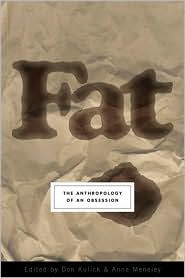 is about how fat in any society is never just about weight or health or looks. Instead, fat is a symbol, a mirror we can gaze into to glimpse the things society tells us are the fairest of them all-and the things society tells us are the grossest, least fair of them all. Looking closely at how people think about fat tells us a lot about how they think about the world in which they live.” – Don Kulick and Thais Machado-Borges in Leaky in Fat: the Anthropology of an Obsession
“…left to itself, stuff tends to modesty. There is a natural humility to things, in that they work best as the frame that guides our sense of what is appropriate, rather than as things we pay regard to in their own right. This tendency can make stuff quite powerful when put into the service of ideology. when someone tells us we should do this or be that, we bridle and feel put upon. When this message is carried, not by a hectoring voice, but well hidden with the mere substance of apparently silent stuff, we are less likely to sense our disempowerment.” – Daniel Miller in Stuff
“In that tradition (of Marxist analysis), ideology stood for paradox; that as a process of objectification people may well understand themselves in the mirror of the world they live within. but what happens when that world is created by others, rather than by themselves? If they see themselves in that world, then it would follow that they now misunderstand themselves” - Daniel Miller in Stuff

Wednesday, October 27, 2010

Food Sovereignty, Women, and Peace

 To that end La Via Campesina has come out with a statement about how food sovereignty is connected to ending all forms of injustice against women.
Women united for food sovereignty and against violence towards women
 Raj Patel expands on this in his book The Value of Nothing
'”At their conference in Maputo, Mozambique, in 2008, La Via Campesina cam up with a new slogan and series of strategies around food sovereignty in which they’re explicitly targeting transnational corporations, in a move that focuses and unifies its various branches. the new slogan is the most revealing, because it put’s society's most pervasive inequality of power front and center “Food sovereignty is about an end to all forms of violence against women.”
…their latest declaration shows an understanding of hunger as the most recent manifestation of millennia of exploitation, and of the distortion of relationships around how value is set. they diagnose the problem of hunger and poverty not as a shortage of food but as a lack of power…La Via Campesina (is) organizing their countermovement in response to the spread of capitalism that not only turns land work into commodities, but turned workers themselves into private property.” (p. 124, 125)
 So then I suspect that the work that MCC is doing will actually be framed with a good deal of what might legitimately be called violence as it works proactively to address the injustices of places like Nepal.
I (heart) Alberta Beef
Weight Log: 222 lb
Look I am not a conspiracy theorist – let’s just get that out of the way! I know and love many farmers and related industry workers. I would never suggest that the public was conspired against to ease the effects of mad cow disease (especially on Alberta farmers where over 40% of Canadian cattle reside). With that disclaimer out of the way let me suggest something interesting in the coincidence of recent history. Notice if you will what seemed like a largely uncorrelated coincidence at the time – namely the popularity of an old weight loss diet developed by Dr. Robert Atkins and the height of the mad cow crisis in North America. Both of these phenomenon occurred concurrently in 2003.
 At its height, the Atkins diet controversial as it may have been, had 1 in every 11 Americans using its prescriptions in order to lose weight. Popularly understood to be the meat diet – this program based its low-carb. plan on science that supported a protein rich nutritional intake that would inevitably reduce weight. It is more than a little interesting that mad cow disease reared its ugly head during this time as well.
 Mad cow disease arrived largely due to the practice of feeding beef to beef. In other words, left over bits of animal (especially the nervous system tissues) were incorporated into the feed that other beef animals were given to eat. Since the original flesh was contaminated with the disease – the feed was also contaminated and then so were the animals that ate the feed. As a result whole herds of animals were exterminated in order to insure the safety of North American food supply. Borders between countries were closed to exports and imports of beef products. And there arose a substantial protest movement in Alberta and other places that sought to support the crashing beef industry. The ubiquitous I (heart) Alberta Beef signs seemed to spread like chicken pox on a toddler. In the end a number of beef producers were forced into a position of bankruptcy despite the rallies and barbeques and prayer meetings.
It is more than a little ironic that a diet plan advocating meat/protein thrived in a period in recent history when a major source of meat in North America was experiencing turmoil. The question is not about whether the beef industry orchestrated this coincidence of history – I will leave that to other more pedantic speculators…
What appears as interesting is when you ask a question like: Was choosing the Atkins diet in ‘03/’04 a political act of support for the beef industry or a desire on the part of individuals to lose weight? In other words, were individuals choosing to go on the Atkins diet because they wanted to show solidarity with the beef industry or was a it an attempt to configure their lives and body images toward the conventions of society? A fairly cursory survey of the research suggest that no such study has ever been conducted so we are only left with speculation. But the actual result of such a study are not critical to be able to ask some significant questions about the collision of these two phenomenon on the socio-political scene.
In what ways can our choice of food resist the impending peril that is understood to be available in that type of food? If one in every 11 Americans were on that diet we can surmise that a substantial number of Americans were either completely oblivious to the potential dangers in the food they were eating or were willing to accept the risk associated with eating this type of food. In either case one might wonder what it was about the power of the Atkins diet that could produce such a great affinity for its weight loss plan. What narrative explanation was at work in allowing both protest rallies and diet adherents to forgo the warnings of substantial regulatory bodies in eating meat? The answer here might give us a clue about the ways in which resistance is meaningfully constructed on a social basis. This might allow us to unravel other ways that social resistance is constructed and maintained.
Daniel Miller in “Stuff” talks about the idea of resistance.
“When someone tell us we should do this or that, we bridle and feel put upon. When this message is carried, not by a hectoring voice, but well hidden within the mere substance of apparently hidden stuff, we are less likely to sense our disempowerment.” – p.82
buzz
 Weight Log: 223 lbs
How do the big shots in Hollywood predict which movie is going to be the next big blockbuster? Well the simple answer is that they really cant predict which movie will be the next big deal. Jonah Lehrer, a contributing editor for WIRED magazine, recently wrote an article in the Wall Street Journal about how buzz works. (read article here) The interesting thing is that the idea of buzz is not only associated with movies but also with any other product available to the potential consumer. That’s what peaked my interest. Lehrer talks about some research on buzz that Northwestern University sociologist, Brian Uzzi, has helped pioneer. In this study he used a huge sample group to analyze how their responses to current movies btwn 1999 and 2001.
Here’s what he found…
“The question, of course, is what generates buzz in the first place. Mr. Uzzi's answer should strike fear into studio executives' hearts: He found virtually no relationship between levels of pre-release buzz and the ad budget of the movie or the presence of highly paid actors, even if millions of dollars were spent. The data suggest that pre-release buzz is mostly unpredictable, driven by intangible factors like the originality of the premise, the title of the film, or even a throwaway line in the trailer.”
So basically none of the conventional methods of generating attractiveness to a product necessarily work very well. In fact one could conclude that being intentional about making your product attractive or desirable may not actually have much affect at all.
“The new buzz research has important implications for marketing. While the old model of advertising is all about reaching individual consumers - Mr. Uzzi argues that future strategies should focus on getting consumers to spread the message themselves. At the moment, the science is short on practical recommendations. As Mr. Uzzi notes, the most cost-effective way to generate buzz is to make an exciting product, to create something that people want to talk about.”
Make something that excites people’s imagination and they will spread the news and reproduce engagement on the part of their friends and acquaintances. This means that while there continues to be a persistent cult of individualism in society – it is clear that basically we like what everyone else likes and we adopt their preferences as our own.
“The new buzz research demonstrates that we're much less autonomous than we imagine. Everything we do is shaped by everyone else.”
Conformity persists.
This idea gets really greasy when it is applied to food – especially to diets or food products that claim to be healthy or reduce weight or whatever. If we are as intertwined as this study suggests then the idea of something being actually healthy or slimming may quickly disappear as meaningful since we are  influenced so strongly by the opinions of others. Whether one food item is actually healthy is not as important as whether our social networks are excited about that food product. They may indeed be excited about it because of the perception that it is healthy but it needn’t be healthy at all. Pick any one of the recently marked super foods as a prime example.
Sweet potatoes are healthier than regular potatoes. In fact, we may be missing out on important nutrients if we don’t eat them. But whether or not they actually are healthier makes little difference when you are sitting down at your local post event restaurant for a delicious plate of deep fried sweet potato fries with that tangy chipotle mayo dipping sauce. So why did you pick those fries, because they are healthy, because they taste good, or because under the influence of your peers you have come to regard them as the latest greatest choice to show off your engagement with what is hip? Or some combination thereof?
Tuesday, October 26, 2010
leaving marx on my shirt

Karl Marx was one of the first dudes to describe the idea of alienated labour. This idea of alienation stemmed from what he saw as a problem with the emerging system of production in the burgeoning industrial revolution. He look at the factories of the day and saw that the only thing that an individual actually owned was the effort or work that he could put into making a product. Whereas before if a farmer milked a cow – the milk that he got would belong to him through his effort in getting it. Now since he was working for the multi-national dairy industry (he-he) all he had to show for his effort was the wage that his employer paid him for the effort he had expended in getting the milk. The worker then is alienated or disconnected from his labour/effort.
Alienation is something I think about a lot while I am walking on the treadmill. In some ways, the effort that I expend on that thing makes me very connected to the product of my labour. I see/feel my body getting thinner and more energetic. In another way I am completely alienated from the product of my labour. There is no actual product after an hour of walking and lifting weight –except for the sweat on my shirt (which would be there no matter what kind of work I would do).
I got to thinking that these two hours a day end up being a great place to think about work, weight loss and alienation. I realized one day that this same energy I spend everyday ‘getting fit’ could possibly be used to say…work on a house for someone who doesn’t have one. I could also be using that same effort to earn money for my family. All these things might still leave me alienated from the product of my labour but at least it would be something of value in this social context.
Instead, I have decided to spend 1.5 to 2 hours everyday shaping my body according to some arbitrary standard of body image that I am willingly subjecting myself to. What does that say about how we see our bodies? What does that say about society? What does that say about me?
Watch this – but be warned its not pretty and I’m not really all that proud of it!

leaving marx on my shirt
Monday, October 25, 2010
conciliatory music
weight log: 221lbs
All of you to whom I can extend solidarity – a conciliatory anthem as a proactive apology for any potential offense…

Subscribe to:
Posts (Atom)