
Monday, June 21, 2010


Wednesday, March 24, 2010
Altruism: a useful fiction?

On the surface one might suggest that it is possible. When I go shovel my neighbour's driveway when he is terminally ill with cancer – that could be considered truly selfless. Right? I mean he has does not have the ability to repay me for it in kind and if I refuse to accept any other sort of payment for the work then I have indeed met the obligation of a truly altruistic action. Right?
Could it be that there is more to it than that? Is it possible to think about every human action in the same way that Newton thought about physical objects in motion? If this is true than we should be able to construct something akin to a relational action equation with a zero SUM. What happens on one side of the relationship must be balanced with an equally significant action on the other part.
So I mow your lawn when you are out of town and you mow mine when I am out of town. This then in mathematical terms is a reciprocal relationship. You can easily see how we can put an equal sign between these two actions. But what about the snow shoveling scenario? It would seem that the two sides of the relationship are not equal since I will not be getting anything in return for my action. But is that really true?
If I do something for my neighbour, I still actually get some things coming back to me across that equation even if they do not come directly from the person I am serving. The first thing I get back is a good feeling. Add to that the idea that by doing this action I am meeting my obligations to my religious beliefs which add to my sense of accomplishment (in some religious systems these acts of kindness might qualify me for greater eternal rewards as well). Not only that this action gives me a better standing in society. When my neighbour’s kids come over and he mentions that I did this nice thing for him well they are impressed and feel they owe me something. Even if I refuse to accept anything – they will talk to their friends and family and in the end my personal rating go up. I have more money in the relationship bank. Now in fairness if I did it completely anonymously no one would know that I did it so that social capital would not increase for me.
But even in the case of the anonymous giver – the gift itself can be enough payment. Think of the anonymous donor of a million dollars to a hospital. Does she get increased status? Well it would seem not except that when it comes to being sick this person will ultimately benefit from the increased capacity of the organization to which they have given money. So we can’t say that the action is disinterested or that there is no return on investment.
If I do something out of a sense of duty – it means that I accept that there is already a deficit in my relational account. I accept that I owe society a debt of selflessness for what I have already received. Duty works like a mortgage in this case and it forces us to accept that we are inherently in a deficit position toward others. Duty constructs the self as a perpetually deficient entity that necessarily needs to repay the debt which the self has accrued – naturally.
So maybe there is no such a thing as a truly altruistic action. Maybe real selflessness is a fiction that works conveniently to reinforce our sense of duty toward each other which in turns us into depreciated goods in constant need to redeem our deficit…
Sunday, March 14, 2010
My new favorite song...
Last nights concert was exceptional for many reasons. One of them was the much anticipated performance of Alexisonfire. The song "The Northern" performed in their inimitable style was a definate highlight. Here is an interesting acoustic version of it. I think there are some pretty fascinating messages behind this adaptation of this old spiritual...
Tuesday, March 9, 2010
God is in our Brain
So Lionel Tiger says (basically) that God is a creation of our brain. Religion is essentially beneficial to humanity because of the effect that it produces on the neurochemistry of the brain. He contends that people like Dawkins are silly to argue against religion since about 90% of human population finds religion to be beneficial. What Tiger is forced to admit that this in no way can definitively prove or disprove the existence of God. He contends that whether God exists or not the brain is uniquely structured to produce and interact with religion.
This is good news on several accounts:
1. Atheist claims that the belief in God is a less evolved and therefore evidence of a less developed intellect is greatly unsubstantiated. In other words, just because you believe in something doesn’t make you a less intelligent being.
2. Any rigidity (dogmatism) about the nature and content of faith must be challenged against the knowledge of central role that the brain plays in producing religious content.
3. Vital importance can be placed in how religious discourse can inform the common values that will enable greater harmony and peace in humanity.
Of course many will be concerned that this claim only serves to limit God to the manufacturing process of our cerebral cortex. This is a narrow view of this important work. Instead it can hopefully provide an impetus to explore the mysteries of the brain in order to better understand the interaction between the divine and humanity…
Here is an interview on the Current if you are interested…
God's Brain: Amazon.ca: Lionel Tiger: Books

Wednesday, February 24, 2010
Placebos and Antidepressants

Please understand that I mean no disrespect to anyone for whom psychoactive drugs are a part of their regimen. This article does not deny that these drugs work but I think it is worth a look. There is a related article in reaction to these findings from a doctor so take it as you like…
Why Antidepressants Are No Better Than Placebos - Newsweek.com
Friday, February 12, 2010
Dangers of the Luddite Resistance
I share a kindred spirit with the luddite approach to the ever expanding technologies in our society. I resonate strongly with the arguments about how emerging technologies are changing our social world (usually for the worse). There are numerous critiques of the impact that these new media have on our cultural frame. The most compelling of these is the problem of an alienated self in a virtual context producing inauthentic communication between subjects. Of course there are significant questions about how use of technology interferes with safety and health (i.e. radio towers and texting while driving). But these more symptomatic problems only mask the larger questions:
How is morality affected when individuals’ main interaction is in virtual formats? Is there any way to mediate the multiple representations that can potentially emerge in these virtual social frames? What are the consequences for transgressions which occur in this virtual reality?
These questions beg answers because by definition the representation that occurs within these media is seen to be a less complete form of reality than pre-technological interactions. One of the natural impulses that surfaces is the luddite sentiment that suggests that new technologies be abandoned to avoid the encroachment of these technologies on more authentic forms of representation. The argument runs this way: Avoid technologies and return to or maintain your authenticity. This argument assumes that there is, in the least a more true version of yourself (the subject) that is achieved without the use of new media forms. But this premise is only supported rhetorically and not logically. It is clear that falsification of personality is possible in any form of interactive representation.
“But,” the critics say, “what is more real? The person on facebook or the person that I sit down for coffee with at Tim Horton’s?” This seems like a legitimate challenge and suggests that the interaction of individuals within each other’s presence is more real. But the question itself is silly. Reality is the perception of a representation. This makes reality a fiction. Fortunately, it is a fiction that we can rely on with a great deal of confidence most of the time. This is not really a problematic premise until one claims that something is more real than something else. This premise (that reality is a fiction that we can have confidence in) also allows us a helpful way to solve our problem about technology.
Using this idea we can argue that a facebook personality can be just as real or unreal (authenticity) as a personally present interaction. This is true because nothing is anymore real than it is perceived to be. Of course people can misrepresent themselves on Facebook but then they can do that in person as well. The level of authenticity is left up to the person viewing the interaction. Its about our perception. So if Facebook is not any more or less real than ‘face to face’ conversations, we can turn to other ways to evaluate the role of new media in our social frames. But let’s leave that there for now.
One of the things that we can say about reality is that it functions well. That is to say that reality works and is useful. This is what allows us to live out our days in relative bliss. We ‘know’ that whatever happens in the kettle produces perceptible steam and when poured over ground coffee produces a delicious beverage. We call what happens in the kettle – boiling. Boiling is real to us because it works. From this perspective we can say some interesting things about new media. Interaction on Facebook is real because it is used (primarily as a communication tool although Farmville might be a close second) and because it is used it shapes our perception of reality. Facebook then becomes part of the perception of reality and intrinsic to it. Facebook, twitter and the like are ubiquitous in society and so have come to be significant factors relied on as useful in social interaction. To not be using Facebook then means that one is choosing to disengage from a significant tool of perception used in the public social sphere to produce reality. The argument then can be made that this disengagement is in fact an appeal to less reliable construction of reality since it is avoiding a prominent tool used to perceive reality by society.
What we can and should be doing is seeking to understand the ways that these new media inform our perceptions of reality so as to be able to participate more fully in the prevailing discourse that exists in our social frame. This begins with careful critique of the dynamics of morality, disclosure, identity construction, subjectivity, rapidity of information as produced in the systems that these emerge from these media. This could not be more relevant than to those who would seek to influence the rhetoric that runs through our society. Teachers, clergy, politicians and journalists are obligated to be present in these media or risk losing opportunity to contribute to the frames of our culture.
I return to my sentiments at the beginning. I lament the perceived changes produced by these new media forms. But I must acknowledge that these laments are perhaps my sense of loss of the exercise of power that once was available through the older forms of interaction. It is like learning a new language. In the old language there was an ability to persuade but now with new vocabulary and new sentence structure I must learn to make meaning in different ways. I must relinquish my claim on authority (which I must admit I am uncomfortable with –even if it was my own deluded sense of authority). I can choose to keep on speaking my old tongue and I will certainly get by but I will be a reduced person unless I can master the new language to regain my former identity.
I am open to critique since there is a strong underlying sentiment to reinforce my luddite sympathies. There likely is flaw in all this mess so wail away…
Here is an interesting experiment that was conducted along this vein.
CBC’s Q radio program interviewed Janic Tremblay – it was a provocative interview – i hope they post it soon. I will link to it if I see it come up…
Friday, February 5, 2010
Watching the Super Bowl with Stanley Milgram
As you all cuddle up to your favourite television set, eager to inhale the vacuous advertising goo (‘cause let’s face it we really are not that interested in the actual game being played), perhaps these three short videos will provide a cunning foil to the event’s delicious advertising candy.
Stanley Milgram preformed some experiments back in the early 60’s where he tested participants willingness to obey objectives even at the risk of delivering deadly shocks to other people.
It should not be lost on us that Milgram’s parents were Jewish survivors of the Nazi death camps. While this study has since received substantial criticism for its ethical standards it is nonetheless a phenomenal study of human capacity for obedience.
Given the right set of conditions people, it seems will obey the authorities in their lives. It might be surprising that this is a common feature of human nature. It certainly raises significant issues of about the way we construct morality and how free will functions practically in the realm of everyday functions.
But perhaps the most stunning revelation that this experiment illuminates is the underlying tendency for us to obey. It seems if we can somehow defer responsibility away from ourselves we are can rationalize some pretty horrific actions.
So when those commercial dance and sparkle in front of us – will we allow their authority activate our obedience? Will we defer our responsibility for our participation in the evils of consumerism to some other higher authority or will we take our own finger off the switch that decapitates our world?


Monday, February 1, 2010
The Value of Nothing
Consider this…
Driving to school today I listened to this interview with Raj Patel (scroll down to “The Value of Nothing” section and listen to the whole interview). Listening to this interview made me think about the confession that I made in the previous post.
Patel’s premise is this: we have come to understand the value of something to be equal to the price we pay for it. On the surface this seems like a reasonable premise. We buy two burgers for 4 dollars at A&W and think we are getting great value because these two items are priced so cheaply. But we do not give even a thought about the costs that are hidden in producing those two burgers. The fact for instance that we can have fresh tomatoes on those burgers means that there are people around the world who necessarily work as indentured slaves to pick those tomatoes. The cost of those burgers also does not include the cost that eating those burgers has on our health – and subsequently our health care system and our ‘productivity’ as employees. These costs are born out in ways that we have come to ignore.
Think about this question: Is the work of raising children valuable to society? Few would say no. Yet where in the capitalist system is that work incorporated into the price of what we pay for things? In fact the trend still exists to pay women less for work of equal value and to limit their ability to access the same the type of jobs due largely to the fact that they (women) are mostly asked to be the ones to raise children. Yet we have a climate as Patel suggests where the singular factor that controls our sense of worth is the price (wage) that is achievable by an individual. It is impossible to get away from this notion. The prevailing notion that drives our social system (especially in Western society) is that price = value. What this does is marginalize every other tool that is available to measure worth.
Is the ability to bear children valuable to us? Absolutely! But when was the last time you heard someone talk about the value of a womb or the value of the time required to effectively parent a child.
Perhaps it is time to take a grim look into how we fix value in our world. Maybe its time to revisit the tools Jesus used to measure the value of things and to forsake our pre-occupation with price…
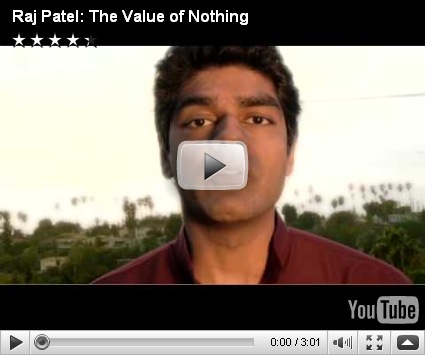
Raj Patel » Blog Archive » The Value of Nothing
For Facebook readers please visit my blog site using the link at the bottom of this post to view the video included in this post.
In case you were wondering the today the CBC did not run a story on Haiti as its headline news…
Sunday, January 24, 2010
Repentance
Haiti, I mourn your loss. I grieve your pain.
My television shows me the scars on your body but it can not convey the deadly toll this takes on your emotional, and mental well-being. Haiti, your fatherless daughters and motherless sons are wailing in my ears but I can conveniently shut them off with click from my remote in my well-worn chair. Haiti, your broken bones and amputated bodies are a fabulous spectacle that keeps me wrapped in undivided attention till I find some other distraction. There is nothing I can do to conjure up how your amputated spirit must be writhing in pain – without anaesthetic!
Yet I see you dancing and singing in the streets – foolish resilience it would seem. I have heard some say that you deserved the devastation brought upon you – for your Godlessness. God’s judgement they claim. Yet you sing and praise this God in ways few expected. Please forgive those arrogant remarks for we in our own Godlessness should have summoned the unleashed gates of hell itself upon us compared to your contrite heart.
A man said today that earthquakes do not kill but buildings do. The buildings you built were the best you could afford but they weren’t the best that could have been built. Haiti, your international debt was so staggering that your government was powerless to enforce the proper building codes. It was a puppet of the ‘global’ interests of large multi-national corporations. These corporations came in to your country and demanded cheap labour from you because you were so deeply indebted to them and their ‘monetary fund’. So you worked for them for less than $2 a day.
You worked cheap for them so that I could buy a $10 T-shirt at Walmart to cover my obesity. You worked cheap to harvest bananas so that I could eat ripe ones on any day of the week in January. In fact the bananas that you wanted to buy from your own farms were more expensive than the ones from Delmonte. So you bought their bananas instead of the ones your neighbour grew. You even cleaned up your beaches to let my countrymen come and play on them. You cleaned up your women so that they could sleep with them as well – for cheap. You let these big companies build extravagant resorts so that my fellow countrymen could play there – indulge there. You got to go to these hotels as well to clean up after our indulgences. And then you got stuck there. Barely able to eek out a living you fought your friends for the ‘best’ jobs. And your life became dependant on our desire to visit your beautiful island. Your good fortune was married to our whim.
So you did not have the money to build the kind of houses they build in LA that can withstand the shaking of the ground. No one even suggested that a better way to build your homes, your country and your nation might be available. Now you scramble to find a tent to live in under the blazing sun and unrelenting rain.
I am your disaster. I am the cause of your demise. The earth shook but I was the one responsible for your pain. My greed. My consumption. My ignorance. My indifference. My oversight. My quest for pleasure. I am the force that crushed your mother. I am the reason your sons are gone.
Please forgive me.
I repent of my gluttony and I confess my obsession with consuming. I look down the long list of things that mark the entries of my Mastercard bill and I am ashamed to tell you that last week I spent $4 on two hamburgers for myself. I see how corrupt I have become and the pain I have caused you without even really intending to. I swear to you and the God we plead to for help that I will change. I will root out the spectre of consumption in my life. My monthly statements will be different.
Please, Haiti, do not hold hatred in your heart for me or my fellow countrymen. We did not intend harm to you. And we are starting to see our own hearts in the light of your tragedy and in the light of the great Master who once said, “Do not store up for yourselves treasures on earth, where moth and rust destroy, and where thieves break in and steal. But store up for yourselves treasures in heaven. For where your treasure is, there your heart will be also. The eye is the lamp of the body. If your eyes are good, your whole body will be full of light. But if your eyes are bad, your whole body will be full of darkness. If then the light within you is darkness, how great is that darkness! No one can serve two masters. Either he will hate the one and love the other, or he will be devoted to the one and despise the other. You cannot serve both God and Money.”
I pray someday your nation will be restored.
Subscribe to:
Posts (Atom)